Turn Button Clicks Into Successful Actions
Six things happen before the spinner stops Help users complete important actions with less friction, fewer mistakes, and more confidence.
The business goal
Help users complete important actions with less friction, fewer mistakes, and more confidence.
The UX choice
Use Behind the Button as a deliberate product decision, not as decoration or a default component.
The starting point is simple: Six things happen before the spinner stops. The interface should make the user's intent visible, keep the consequence of each action understandable, and remove friction only where it does not reduce trust or control.
Why this choice works
When this pattern is treated as a business lever, it can reduce hesitation, prevent avoidable errors, and make the next action feel obvious. When it is added without a clear purpose, it can create noise, hidden behavior, or unnecessary friction.
For a startup, this matters because small UX decisions compound across acquisition, activation, retention, and support. A clear pattern can shorten the path to value. A confusing one can turn a moment that should feel routine into a reason to abandon the product or contact support.
What to design
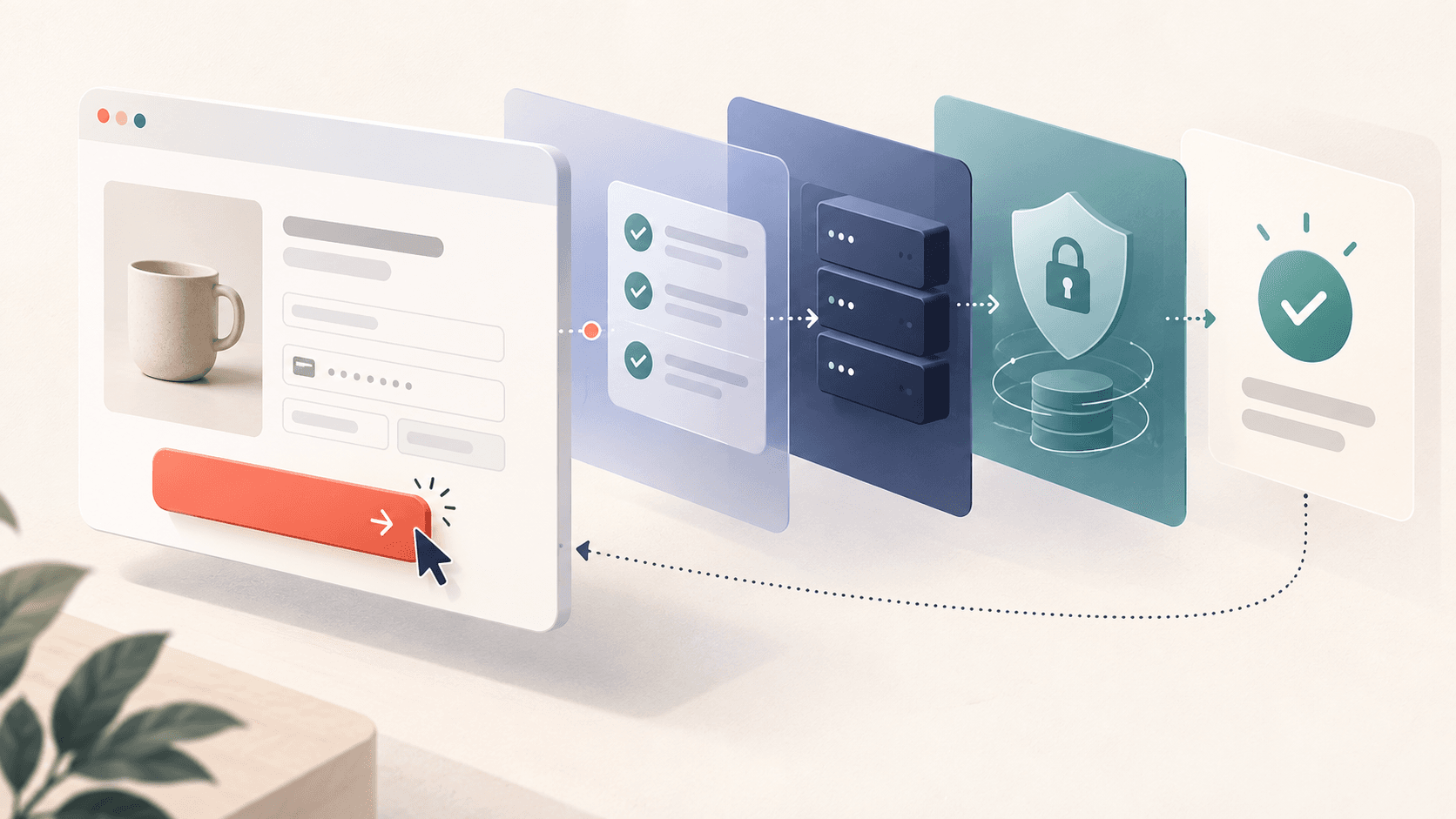
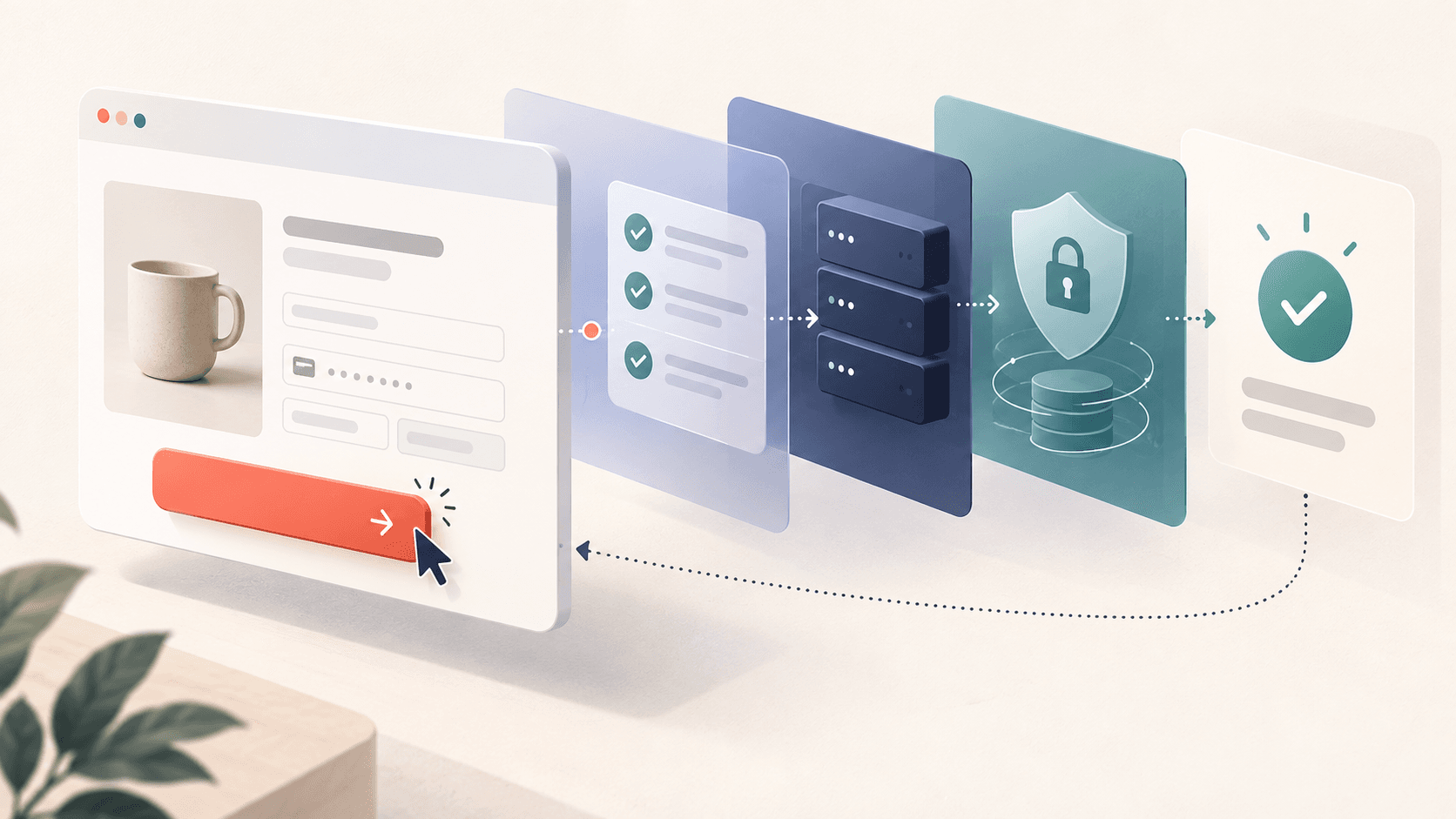
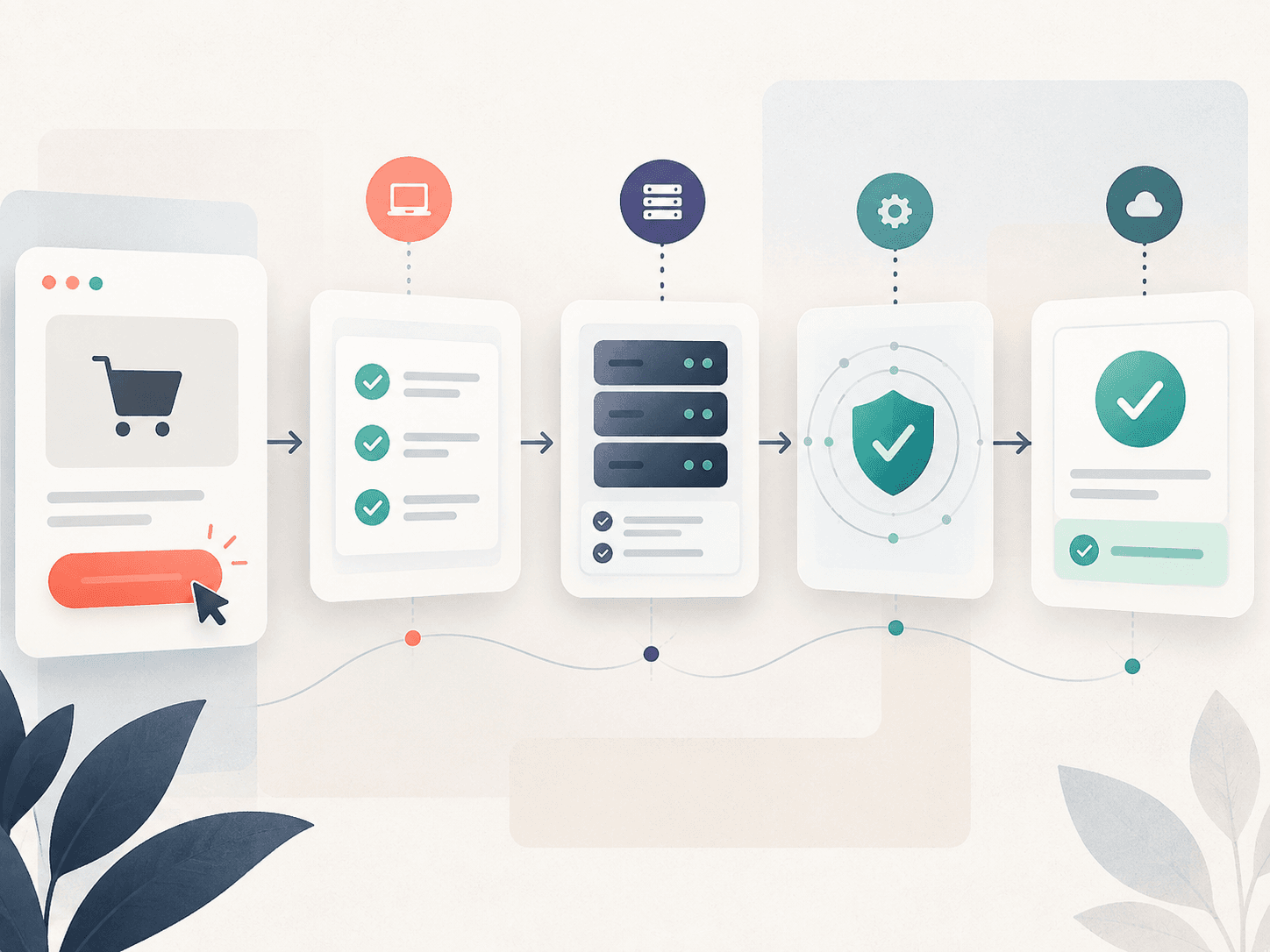
- Client-side validation exists for speed, not safety. Green checks and inline errors fire with 0 network calls because catching mistakes instantly is a frontend job.
- The server re-runs every check the client already did, only stricter. Never trust the client: anyone can forge a request, so re-compute the total from your own catalog instead of believing the price the browser sent.
- Wrap the related writes (order, items, inventory, payment) in one transaction. If a single row fails, every row rolls back, so an order never lands half-written. All of it, or none of it.
- When the response returns, repaint the UI with server truth, the real order ID the server created, not a value you guessed locally.
- Optimistic UI fits cheap, reversible actions: a like, a favorite, a rename can repaint instantly and reconcile in the background. Money is different, so hold the spinner until the server actually confirms.
Practical implementation rules
- Validate on the client for speed and on the server for trust, never one instead of the other.
- Re-compute prices and totals server-side from your own source of truth.
- Wrap multi-row writes in one transaction so any failure rolls back the whole thing.
What to avoid
- Trust values the client sends, including the price, since a request is trivial to forge.
- Reach for optimistic UI on payments or other irreversible actions; make them earn the spinner.
Do not copy the pattern mechanically. First identify the user decision it is supporting, then choose the simplest version that makes that decision easier. Test the design with the real content, real device sizes, keyboard navigation, and slow or failed network conditions where relevant.
Easystartup publishing angle
Frame this topic around a familiar startup problem: how a small product decision can improve a measurable business outcome. Use an example from onboarding, checkout, dashboards, or marketing pages so readers can connect the UX principle to work they are already doing. The strongest takeaway is not a visual rule by itself; it is the reason that rule helps users move forward.
Quick takeaway
A good Behind the Button choice is one that makes the user's next step clearer while supporting the business outcome behind that step. Start with the goal, then let the UX pattern earn its place.
Ready to make your website work harder?
Start a WhatsApp conversation about your website. We’ll help you understand what’s possible — no pressure, no jargon.